Best Portable Power Stations for Home Backup in 2026
Compare home backup power stations by watt-hours, AC output, UPS behavior, solar input, fridge runtime, expansion, ports and mobility.
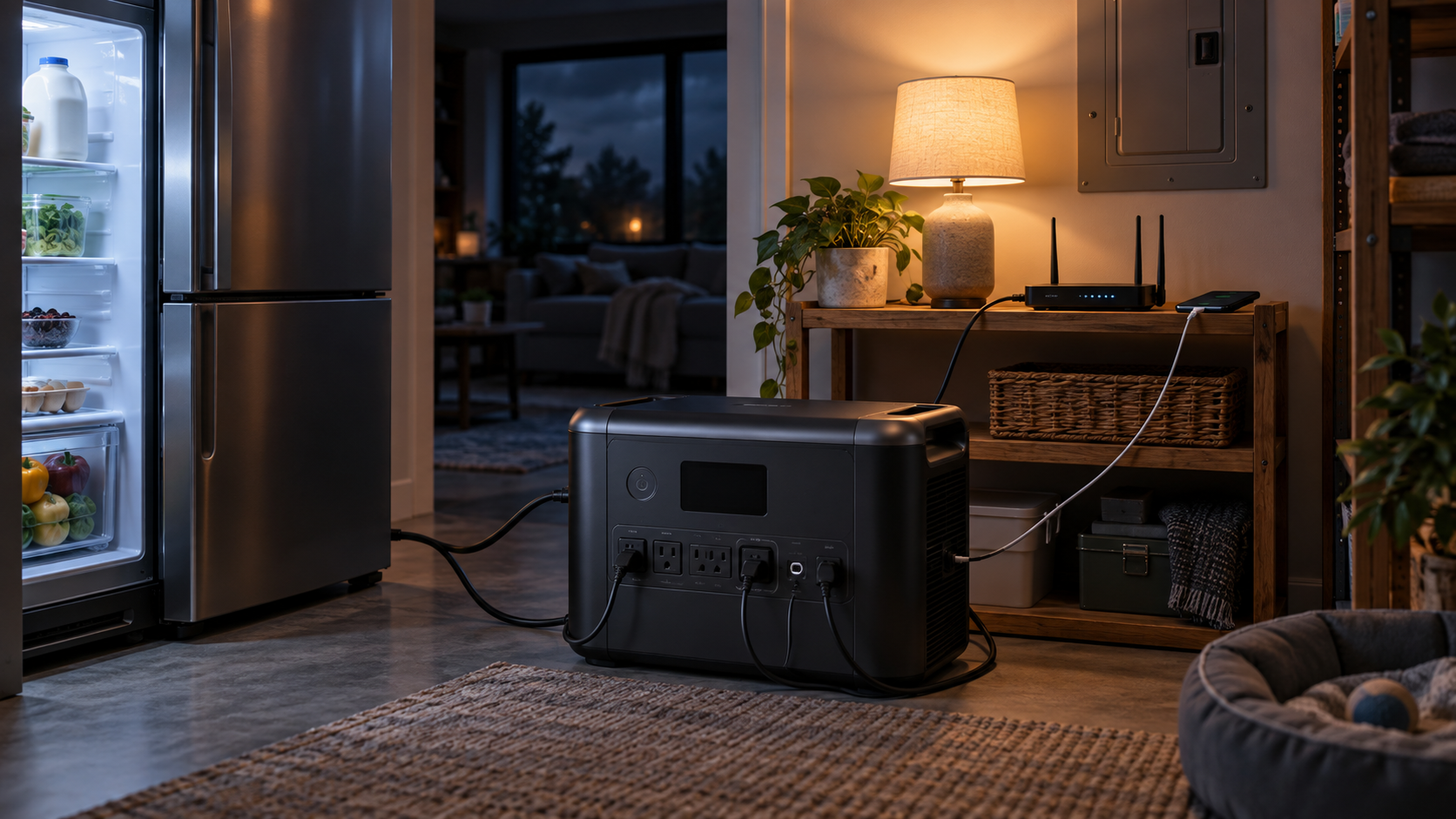
At a Glance
A home backup power station should be judged by usable watt-hours, inverter output, recharge speed, UPS behavior, solar input and whether it can actually support the loads you care about. A big battery is not automatically a home backup system.
This guide compares real battery systems with current product pages, published specifications, product images and listed feature details. The focus is refrigerator backup, router and device power, short appliance bursts, expansion potential and whether the system is realistic for a household outage.
5 Criteria to Look For Before Buying a Portable Power Stations for Home Backup
Key buying criteria so you get the right fit the first time.
Separate output from energy
A 2,000W inverter can start more loads, but watt-hours decide runtime. The C1000 Gen 2 has strong output for short use, while the HomePower 3600 Plus has much deeper stored energy. Compare both numbers.
Plan refrigerator runtime honestly
Refrigerators cycle, so runtime depends on model, room temperature and door openings. A 2kWh unit can be a strong fridge-backup class, but a 1kWh station may need careful use and recharge planning.
Check UPS behavior before relying on it
UPS or backup-mode claims are useful for routers and computers, but transfer time and device tolerance vary. Test the BLUETTI AC180 or any station with the actual device before treating it as uninterrupted backup.
Solar input matters after the first night
A battery without a realistic recharge plan becomes smaller every day. Solar input of 400W to 600W can help, but only if Cậu has compatible panels, sun and cable setup.
Know when a transfer solution is needed
Most portable stations power devices directly. Home circuits, 240V loads or larger systems require compatible transfer equipment and professional planning. Do not improvise panel connections.
Best Portable Power Stations for Home Backup in 2026
Jackery HomePower 3600 Plus
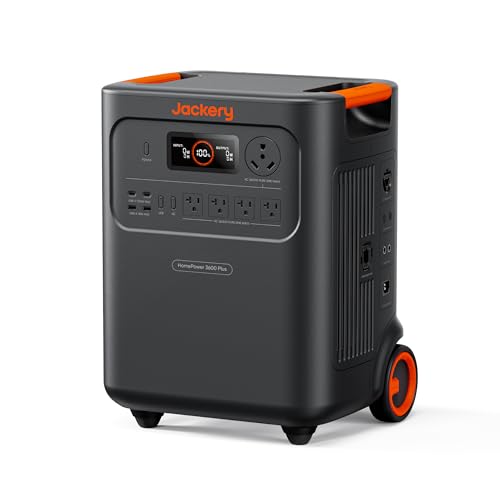
About this pick
The Jackery HomePower 3600 Plus is the best overall home-backup pick because it is built around household loads rather than only camping. The listed specifications include 3,584Wh capacity, 3,600W AC output, expansion to much larger battery capacity and 120V plus 240V operation when used in parallel. That gives it a broader backup role than 1kWh portable stations.
Its advantage is system ambition. The listing frames it for pumps, heaters, dryers and multi-day household backup, while also emphasizing plug-and-play operation with a manual transfer switch accessory path. Charging options include AC, solar, gas generator and hybrid charging, which matters during long outages.
This is not the lightest or simplest battery to buy casually. It makes sense when Cậu wants a home-focused backup platform and is willing to plan transfer equipment, expansion, charging and storage. If the need is only router, phones and one fridge, a smaller 1kWh to 2kWh unit may be more practical.
Best for: Households that want a large expandable battery platform for serious outage planning.
Check price on AmazonSpecs
- Capacity: 3,584Wh
- AC output: 3,600W
- Expansion: Expandable to 21kWh per unit per listing
- Charging: AC, solar, generator and hybrid charging
Pros
- +Large 3,584Wh capacity
- +3,600W AC output
- +Expandable platform
- +Multiple recharge paths
Cons
- −More system than small loads need
- −Transfer equipment planning still matters
- −Heavier than compact stations
Anker SOLIX S2000
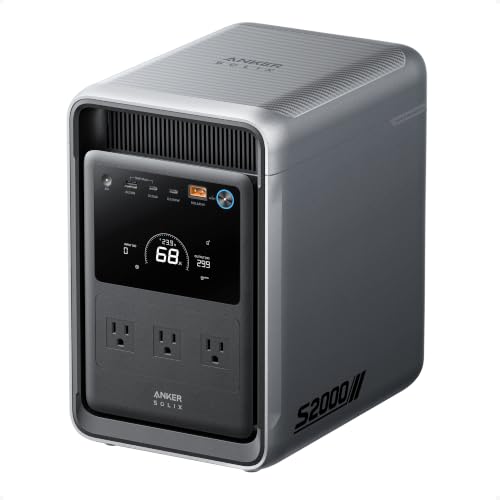
About this pick
The Anker SOLIX S2000 is the fridge-focused pick because its listing directly emphasizes low idle draw and extended refrigerator backup. The listed specifications include 2,010Wh capacity, 1,500W continuous output, 3,000W peak output, 400W solar input and a 35.7-pound weight claim. That makes it a strong middle ground between compact stations and large home systems.
The 2kWh class is useful for refrigerator cycling, internet equipment, lights, phones and selected appliance bursts. Anker also highlights long-cycle LFP battery language and six recharge methods, including AC, solar, generator, alternator and car outlet. Those recharge options matter more than many shoppers realize once an outage lasts beyond one night.
The main limitation is AC output compared with larger home systems. It can run many essentials, but it is not the best choice for broad household loads or 240V needs. Buy it when preserving food, communications and moderate comfort loads is the priority.
Best for: Households that want a mobile 2kWh-class station for fridge and essentials backup.
Check price on AmazonSpecs
- Capacity: 2,010Wh
- AC output: 1,500W continuous, 3,000W peak
- Solar input: Up to 400W
- Weight claim: 35.7 pounds
Pros
- +2,010Wh capacity
- +Fridge-backup positioning
- +Long-cycle LFP claim
- +Multiple recharge options
Cons
- −1,500W output limit
- −Not for 240V loads
- −Solar input still requires panel planning
BLUETTI AC180

About this pick
The BLUETTI AC180 is the best 1kWh-class value for home backup because it pairs useful output with fast charging and UPS behavior. The listed specifications include 1,152Wh capacity, 1,800W AC output, 2,700W peak, 500W solar input and a 20 ms UPS claim. That is a strong feature set for a station in this size range.
Its output is especially useful for short appliance bursts. A 1,800W inverter can handle more than many 1kWh stations, while the 500W solar input can refill faster if Cậu owns enough compatible panels. The UPS claim also makes it relevant for routers, computers and office equipment, though compatibility should be tested.
The limitation is stored energy. A 1,152Wh battery can disappear quickly if used for heat, cooking or high-watt appliances. It is best for refrigerator cycling, internet, lights, CPAP after testing and short-duration appliance use rather than whole-home backup.
Best for: Buyers who want a capable 1kWh station with UPS behavior and strong inverter output.
Check price on AmazonSpecs
- Capacity: 1,152Wh
- AC output: 1,800W, 2,700W peak
- Solar input: 500W
- Backup mode: 20 ms UPS claim
Pros
- +1,800W AC output
- +500W solar input
- +UPS claim
- +Fast AC recharge
Cons
- −Only 1,152Wh capacity
- −Runtime drops under high loads
- −UPS compatibility should be tested
Anker SOLIX C1000 Gen 2

About this pick
The Anker SOLIX C1000 Gen 2 is the compact high-output pick because it squeezes strong inverter output into a portable 1kWh platform. The listed specifications include 1,024Wh capacity, 2,000W output, 3,000W peak, 10 ports and 600W solar input. It is built for emergency backup, remote work and small-space power rather than full-house autonomy.
Its biggest advantage is fast turnaround. A 49-minute recharge claim is useful when grid power returns briefly or when preparing before a storm. The 600W solar input also gives it better refill potential than many compact stations if panel voltage and wattage match.
The tradeoff is that output is stronger than energy capacity. It can power high-watt devices for short periods, but 1,024Wh limits runtime. Choose it for mobility and fast recharge rather than long-running household loads.
Best for: Compact home backup where high output and fast recharge matter more than multi-day capacity.
Check price on AmazonSpecs
- Capacity: 1,024Wh
- AC output: 2,000W, 3,000W peak
- Solar input: 600W max, 60V max
- Recharge claim: 49 minutes with AC fast charging
Pros
- +2,000W output
- +Fast recharge claim
- +600W solar input
- +Compact 1kWh class
Cons
- −Limited stored energy
- −App-enabled fast charge may be needed
- −Not for whole-home backup
Jackery Explorer 1000 v2

About this pick
The Jackery Explorer 1000 v2 is the lightweight 1kWh pick for buyers who want emergency backup that is easy to move. The listed specifications include 1,070Wh capacity, 1,500W AC output, 3,000W surge and a 23.8-pound weight claim. That makes it easier to carry between rooms than larger 2kWh and 3kWh stations.
It is a good fit for phones, router, lights, laptops, cameras, CPAP after testing and short refrigerator support. The USB-C ports, car port and three AC outlets make it flexible for mixed loads. Fast AC charging and app modes also help when preparing for a forecasted outage.
The limitation is household depth. It is not a sump-pump, central-heat or multi-day fridge solution by itself. Buy it for mobility and light-to-moderate essential backup, not as a substitute for a larger home battery system.
Best for: Apartments, small homes and emergency kits where easy movement matters.
Check price on AmazonSpecs
- Capacity: 1,070Wh
- AC output: 1,500W, 3,000W surge
- Weight claim: 23.8 pounds
- Battery: LFP with 4,000 cycle language
Pros
- +Light 1kWh class
- +1,500W output
- +LFP chemistry
- +Multiple ports
Cons
- −Limited runtime for fridges
- −No 240V role
- −Not expandable like larger systems
How We Evaluated These Portable Power Stations for Home Backup
Each pick was assessed across 4 criteria weighted for real-world use.
Backup role clarity
We ranked each station by the job it can realistically handle: whole-home-style platform, fridge-focused backup, compact UPS-style backup or lightweight emergency kit. Bigger output alone did not decide the order.
Capacity and inverter balance
Watt-hours, continuous output and peak output were evaluated together. A station with huge output but modest capacity can still be useful, but only for short bursts. Runtime remained central.
Recharge paths
AC recharge, solar input, generator recharge and car or alternator options influenced rankings. The longer an outage lasts, the more recharge speed matters. Systems with clearer recharge flexibility ranked higher.
Home usability
Weight, ports, UPS claims, expansion, transfer options and app dependence all shaped the recommendations. A home backup station should be easy to stage, monitor and connect safely under stress.
How to Choose the Right Portable Power Stations for Home Backup
Choose by outage length
| Outage goal | Better class | Example |
|---|---|---|
| Hours of router, lights and devices | 1kWh station | Jackery Explorer 1000 v2 |
| Fridge and essentials overnight | 2kWh station | Anker SOLIX S2000 |
| Larger home backup platform | 3kWh plus expandable | Jackery HomePower 3600 Plus |
Use high-watt AC sparingly
Electric kettles, heaters, microwaves and coffee makers can drain batteries quickly. Use battery power for refrigeration, communication, medical devices after testing and efficient electronics before comfort appliances.
Build a recharge routine
Before storm season, test wall charging, solar input and generator charging if supported. Label cables and adapters. A power station is much more useful when recharge steps are practiced before the outage.
Frequently Asked Questions
What size power station do I need for home backup?
For phones, router and lights, 1kWh can be enough. For a refrigerator plus essentials, 2kWh is more comfortable. For larger household backup, look at 3kWh plus and expansion.
Can a portable power station run a refrigerator?
Yes, if inverter output and surge capacity fit the refrigerator and the battery has enough watt-hours. Runtime varies by fridge size, temperature and door openings.
Can a power station run a sump pump?
Sometimes, but pump startup surge can be high. Check the pump rating and test the actual setup. Larger stations or dedicated backup systems may be needed.
Is UPS mode reliable for computers?
It depends on transfer time and the device. Test the station with the actual computer, router or modem before relying on it. Some equipment is more sensitive than others.
Do I need solar panels?
Solar is not required for short outages, but it helps during longer ones. The panel wattage must match the station input limits and your actual daily energy use.
Can I connect a power station to my breaker panel?
Only with compatible equipment installed according to code. Most portable stations are safest powering devices directly unless the manufacturer supports a transfer solution.
Bottom Line
best overall: Jackery HomePower 3600 Plus - best overall home backup pick in this roundup.
See the full rankings above for all picks with pros, cons, and best-for summaries.
Browse on Amazon
All Prime-eligible options with current pricing.
Shop on Amazon →Related Guides
Sources and further reading
Manufacturer specifications and safety guidance consulted for this guide. Always confirm the current manual for the exact model you buy.