Best Portable Generators for Home Backup in 2026
Compare home backup portable generators by real watts, fuel, transfer readiness, CO safety, runtime, outlets and ownership tradeoffs.
At a Glance
A home backup portable generator has to do more than produce a big peak-watt number. It needs the right 120V and 240V outlets, enough running watts for the loads you will actually use, a fuel plan you can maintain during an outage, and safety features that support outdoor operation.
For this update, we selected real models with current product pages, published specifications, and product images. The buying criteria below emphasize transfer-switch readiness, CO shutdown, fuel derating, and the difference between whole-panel expectations and essential-circuit reality.
5 Criteria to Look For Before Buying a Portable Generators for Home Backup
Key buying criteria so you get the right fit the first time.
Size from running watts, not the largest label
The WGen9500DF lists 9,500 running watts on gasoline while the WEN DF475T lists 3,800 running watts on gasoline. Those numbers describe very different outage plans even though both are home-backup candidates. Start with the loads you will run at the same time, then add motor-starting headroom and a reserve margin.
Verify the transfer path before buying
A generator with a 14-50R 50A outlet or L14-30R outlet is easier to plan around, but it still needs proper transfer equipment. The Westinghouse WGen9500DF includes both 30A and 50A home-backup outlet paths, while the WEN DF475T is a smaller L14-30R class. Match the generator to the inlet, transfer switch or interlock, neutral behavior, and local code before relying on it.
Treat fuel as a capacity decision
Dual-fuel and tri-fuel labels hide real derating. The WGen11500TFc is listed at 11,500 running watts on gasoline, 10,500 on propane, and 9,500 on natural gas. A load plan that works on gasoline may need load shedding on natural gas, so calculate with the fuel you expect to use during the outage.
Prioritize CO safety and outdoor placement
The DuroStar DS13000MX includes CO Alert and several Westinghouse models include CO-sensor variants, but no shutoff system makes indoor, garage, porch, or near-window operation safe. Plan the operating location, exhaust direction, cord or inlet route, weather protection, and household CO alarms before the storm arrives.
Do not confuse portable backup with automatic standby
A portable generator requires setup, fueling, startup, load management, and shutdown every outage. If you need automatic operation for medical, accessibility, or frequent-outage reasons, compare standby systems instead of stretching a portable generator beyond its realistic workflow.
Best Portable Generators for Home Backup in 2026
Westinghouse WGen9500DF

About this pick
The Westinghouse WGen9500DF earns the top slot because it sits in the most useful part of the home-backup market. The The published specifications shows 9,500 running watts and 12,500 peak watts on gasoline, plus 8,500 running watts and 11,200 peak watts on propane. That combination gives it enough headroom for a serious essential-circuit plan without moving into permanent standby-generator territory.
The outlet layout is the main reason it fits home backup better than many high-watt portables. It includes a transfer-switch-ready L14-30R 30A outlet and a 120V/240V 14-50R 50A outlet, so shoppers can plan around common inlet and transfer-equipment paths instead of improvising with household receptacles. Remote start, electric start, recoil backup, a digital hour meter, and low-oil shutdown also make it easier to rehearse before storm season.
Do not buy it just because it has a large number in the title. It is still a heavy open-frame generator that must run outdoors, away from openings, and only through proper transfer equipment when feeding home circuits. If your outage plan is only a refrigerator, router, lights, and phone charging, a smaller inverter may be easier to live with.
Best for: Homeowners who want one portable generator for a broad essential-circuit backup plan with dual-fuel flexibility.
Check price on AmazonSpecs
- Gas rating: 9,500 running watts, 12,500 peak watts
- Propane rating: 8,500 running watts, 11,200 peak watts
- Home outlets: L14-30R 30A and 14-50R 50A
- Runtime claim: Up to 12 hours on 6.6 gallons
Pros
- +Strong gasoline and propane ratings
- +30A and 50A home-backup outlet options
- +Remote, electric, and recoil start
- +Longer runtime claim than many smaller portables
Cons
- −Large open-frame noise and weight
- −Still requires outdoor placement and transfer planning
- −Propane output is lower than gasoline output
Westinghouse WGen11500TFc
About this pick
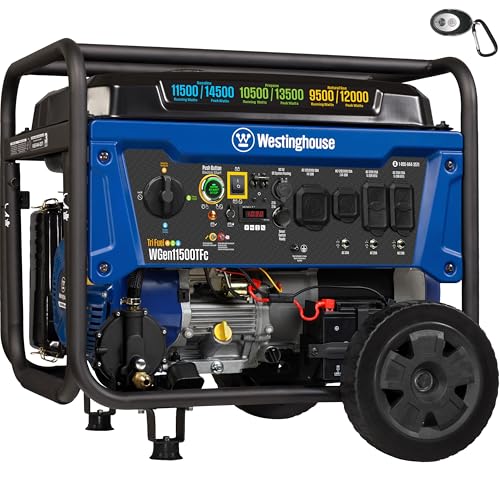
The WGen11500TFc is the pick for buyers who want portable-generator flexibility without depending on only gasoline or propane. The current listing includes gasoline, propane, and natural gas operation, with the highest output on gasoline and a meaningful derating on natural gas. That makes it attractive for long outages if the home's fuel supply can actually support the generator.
Its best feature is not simply tri-fuel labeling. The published ratings make the tradeoff visible: 11,500 running watts on gasoline, 10,500 on propane, and 9,500 on natural gas. That difference matters when you are trying to start pumps, compressors, or multiple home circuits, because a load plan that works on gasoline may be too aggressive on natural gas.
This is a planning-heavy choice. Before buying, verify gas meter capacity, hose length, regulator requirements, and where the unit can sit outdoors. If you are not prepared to confirm the fuel side with a qualified pro, the simpler WGen9500DF may be easier to own.
Best for: Prepared homeowners who want gasoline, propane, and natural-gas options in one portable platform.
Check price on AmazonSpecs
- Gas rating: 11,500 running watts, 14,500 peak watts
- Propane rating: 10,500 running watts, 13,500 peak watts
- Natural gas rating: 9,500 running watts, 12,000 peak watts
- Runtime claim: Up to 19 hours on 9.5 gallons
Pros
- +Three fuel choices
- +High gasoline running wattage
- +Low THD claim for electronics
- +Large tank and long runtime claim
Cons
- −Natural gas output is lower
- −Fuel installation details matter a lot
- −Large and not casual to move
Westinghouse WGen11500DFc

About this pick
The WGen11500DFc is the better fit if you want the large Westinghouse output class but do not need natural gas. It keeps the strong 11,500 running-watt gasoline rating and 10,500 running-watt propane rating from the published specifications, which is enough for a much more ambitious essential-load plan than mid-size generators can handle. The listed specifications also call out low THD, which matters if your backup list includes computers, TVs, networking gear, and other electronics.
Compared with the tri-fuel version, this model is simpler because it narrows the fuel plan to gasoline and propane. That can be a positive if your home does not have a suitable natural-gas hookup or if you prefer stored propane as the long-term emergency fuel. The 9.5-gallon tank and heavy 550cc engine point to extended runtime potential, but the real runtime still depends on load percentage.
The main reason to skip it is overbuying. If you will not install proper transfer equipment or if your actual loads are small, the extra output becomes weight, noise, and storage burden. It belongs with homeowners who have measured loads and know why they need this much headroom.
Best for: Homes that need high portable output but prefer gasoline and propane over tri-fuel complexity.
Check price on AmazonSpecs
- Gas rating: 11,500 running watts, 14,500 peak watts
- Propane rating: 10,500 running watts, 13,500 peak watts
- Tank: 9.5 gallons
- Engine: 550cc OHV engine
Pros
- +High running-watt ratings on both fuels
- +Simpler than a tri-fuel setup
- +Low THD claim
- +Large fuel tank
Cons
- −No natural-gas option
- −Heavy open-frame format
- −Too much generator for small essential-load plans
DuroStar DS13000MX

About this pick
The DuroStar DS13000MX is a strong alternate if you want a large dual-fuel portable with explicit home-backup positioning. The The published specifications highlights a 13,000-watt class, gasoline or propane operation, remote electric start, CO Alert, and a 50A outlet for transfer-switch use. That gives it the right feature set for homeowners who are comparing large open-frame backup units.
The most valuable part of this model is the way it combines a 50A outlet with CO Alert. Many shoppers focus only on wattage, but the connection path and safety layer matter just as much when the generator will be used near a home during bad weather. Push-button electric start and a front fuel selector also make the operating sequence less fussy during an outage.
It is still not a plug-and-play whole-house solution. A 50A outlet does not remove the need for listed transfer equipment, outdoor placement, and load discipline. If you want quieter operation or cleaner electronics-first output, a large inverter generator may be a better match.
Best for: Buyers comparing high-output dual-fuel portables with 50A transfer-switch readiness.
Check price on AmazonSpecs
- Class: 13,000-watt dual-fuel portable
- Fuel: Gasoline or propane
- Safety: CO Alert shutdown
- Home connection: Transfer-switch-ready 50A outlet
Pros
- +50A home-backup outlet
- +Dual-fuel operation
- +CO Alert shutdown
- +Remote electric start
Cons
- −Open-frame noise profile
- −Large size and fuel demand
- −Needs proper transfer equipment
WEN DF475T

About this pick
The WEN DF475T is the budget-friendly pick because it still covers several serious home-backup requirements. The The listed specifications include dual-fuel operation, 120V to 240V selection, electric start, a 224cc engine, and an L14-30R twist-lock outlet. That is a much more useful emergency feature set than a small 120V-only generator when a home inlet or transfer switch is part of the plan.
Its output is modest compared with the large Westinghouse and DuroStar picks. On gasoline, it is listed at 3,800 running watts and 4,750 surge watts; on propane, 3,500 running watts and 4,350 surge watts. That can be enough for refrigerator, freezer, lights, router, chargers, and carefully sequenced small motor loads, but it is not the right unit for broad whole-panel backup.
Choose this only if you are comfortable with an essentials-first outage plan. It is attractive because it is smaller and easier to store than the high-output picks, not because it can do their job. If central air, electric water heating, or multiple large motors are on your must-run list, step up in class before buying.
Best for: Budget-focused homeowners running a disciplined essentials-only backup plan.
Check price on AmazonSpecs
- Gas rating: 3,800 running watts, 4,750 surge watts
- Propane rating: 3,500 running watts, 4,350 surge watts
- Connection: 120V/240V L14-30R
- Runtime claim: Up to 11 hours at half load
Pros
- +Dual fuel at a smaller size
- +120V and 240V support
- +L14-30R outlet
- +More manageable than large open-frame units
Cons
- −Limited running-watt headroom
- −Not for broad home backup
- −Requires careful load sequencing
How We Evaluated These Portable Generators for Home Backup
Each pick was assessed across 4 criteria weighted for real-world use.
Published product specifications
We used published product specifications for product names, live product page URLs, product images, model information, and listed feature details. We did not use Amazon prices, star ratings, or review counts because those should not be republished in the article. The published specifications helped us confirm real outlet types, wattage classes, fuel options, and safety features instead of writing from generic category assumptions.
Home-backup fit
We weighted 120V and 240V capability, 30A or 50A outlet support, transfer-switch readiness, and fuel flexibility more heavily than campsite convenience. The Westinghouse WGen9500DF ranked first because its 30A and 50A outlet mix fits more home-backup plans than smaller essential-only units. The WEN DF475T still made the list because it gives budget buyers a real 120V and 240V path for smaller loads.
Safety and operating burden
CO shutoff, low-oil shutdown, electric start, runtime claims, tank size, and ease of pre-outage rehearsal all mattered. Large output did not automatically win if the generator created more fuel, storage, or setup complexity than the intended job justified. We also favored models that make the fuel-specific output difference visible so buyers can avoid oversizing mistakes.
Use-case separation
The list intentionally includes both large home-backup units and a smaller budget essentials pick. That prevents the common SERP problem where every shopper is pushed toward the biggest machine, even when they only need refrigerator, lights, router, and charger backup. Each recommendation is tied to a load strategy rather than a generic best label.
How to Choose the Right Portable Generators for Home Backup
Match the generator to the outage plan
Use the large Westinghouse and DuroStar units for broad essential-circuit backup, not for casual extension-cord use. Use the WEN DF475T when the plan is smaller and disciplined. If you cannot describe which circuits will run and which will stay off, pause before buying.
| Backup goal | Better fit | What to verify |
|---|---|---|
| Fridge, freezer, router, lights, chargers | WEN DF475T or a similar smaller dual-fuel unit | Running watts, L14-30R compatibility, cord gauge, load sequence |
| Essential circuits plus sump or furnace blower | Westinghouse WGen9500DF | Starting watts, 30A or 50A inlet, transfer equipment |
| Large home loads with fuel flexibility | Westinghouse WGen11500TFc | Fuel-specific output, gas meter or propane plan, outdoor location |
Plan the connection hardware as part of the purchase
A portable generator becomes a home-backup system only when the connection path is correct. Budget for the inlet, transfer switch or interlock, breaker work, cord, weather-safe routing, and inspection where required. Never backfeed through an outlet or homemade cord.
Rehearse on the fuel you will use
Run a pre-season test on gasoline, propane, or natural gas based on the fuel you expect to use in the outage. Record which loads start cleanly, how much fuel is consumed, where the generator sits, and who in the household can perform the startup and shutdown sequence.
Frequently Asked Questions
What size portable generator is best for home backup?
For essential circuits, many homes land between a small 120V/240V unit like the WEN DF475T and a larger unit like the Westinghouse WGen9500DF. The right size depends on running watts, motor startup demand, and whether any load needs 240V. Do not size from square footage alone.
Is a 50A outlet necessary?
A 50A outlet is useful for larger backup plans, but it is not automatically necessary. A smaller L14-30R setup can work for essential circuits if the load plan is realistic. Match outlet, cord, inlet, breaker, and transfer equipment as one system.
Should I buy dual fuel or tri fuel?
Dual fuel is simpler and works well when gasoline and propane storage are the plan. Tri fuel adds natural gas convenience, but only if the home's fuel supply can support the generator under load. Check the fuel-specific wattage rating before choosing.
Can a portable generator power central air?
Sometimes, but it depends on the air conditioner, startup demand, soft-start hardware, generator size, and what else is running. A large portable may still need load management. Have an electrician or HVAC pro verify the setup before relying on it.
Can I plug a portable generator into my house?
Only through listed transfer equipment or an approved interlock installed according to code. Do not use a dryer outlet, suicide cord, or any improvised backfeed method. The generator outlet being transfer-ready does not replace proper installation.
Is propane better than gasoline for outages?
Propane stores longer and avoids stale gasoline problems, but most portable generators produce less power on propane. Gasoline usually gives maximum output, while propane can simplify long-term storage. The right answer depends on your load plan and fuel rotation habits.
Bottom Line
best overall: Westinghouse WGen9500DF - best overall home backup pick in this roundup.
See the full rankings above for all picks with pros, cons, and best-for summaries.
Browse on Amazon
All Prime-eligible options with current pricing.
Shop on Amazon →Related Guides
Sources and further reading
Manufacturer specifications and safety guidance consulted for this guide. Always confirm the current manual for the exact model you buy.